 |
The Tay/Thai is one of the largest language groups in Vietnam totalling about 3 million people. In the region they are related to the Shan in Myanmar and the Zhuang and Pu Yi in southern China in addition to the Thais and Laos. The Tay with a population of 1.2 million make up the largest section of the group, but more often than not wear clothes identical to modern Viet Kinh. The Thai number over a million and the Nung 700,000. Generally the Thai people live to the South West of the Red River and the Tay and Nung to the North East. Both groups are famous for their weaving and live in stilt houses. Other groups belonging to this language family include the Giay, Lu, San Chay, Tu Di and Bo Y. |
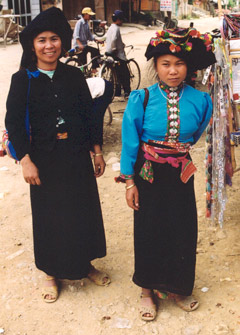
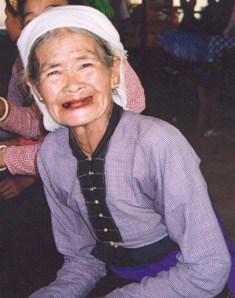
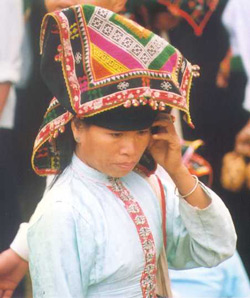
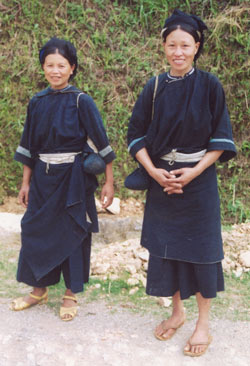
With a total of well over 1,000,000 the Thai constitute the second largest ethnic minority in Vietnam. Of the two groups, the Black Thai are concentrated in Son La and southern Lai Chau Provinces whilst the White Thai are found predominantly in northern Lai Chau and Lao Cai provinces. The traditional costume of the Thai generally comprises a coloured blouse (often green, blue, pink or purple) with a distinctive row of silver buttons down the front, a long black skirt and usually an intricately embroidered and very distinctive black headscarf as with the lady at the top from Thuan Chau. The Thai ladies above are from Than Uyen in Yen Bai province and the lady with the charming smile is from Nghia Lo in Yen Bai.
NB Travelers will encounter many White Thai people in Mai Chau village near Hoa Binh but they only wear their traditional costume when performing dances for tourists.
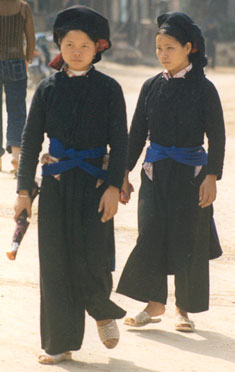
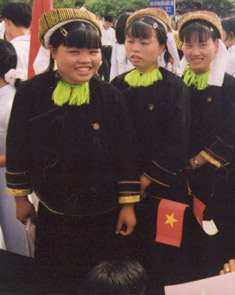
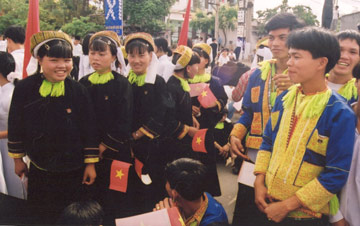
With a total population of over 700,000 the Nung (above left) constitute the seventh largest ethnic minority group in Vietnam. Nung communities are found today mainly in Cao Bang and Lang Son provinces, but they are also settled in parts of Lao Cai, Ha Giang, Tuyen Quang, Bac Can, Thai Nguyen and Ha Bac provinces. The traditional clothing of the Nung people for both sexes comprises a plain indigo vest and trousers often decorated with a coloured belt and won with a black turban covered by a white or coloured scarf. However there are a number of variations in costume. The Nung An (above centre) sub-ethnicity are settled exclusively in the region north east of Cao Bang. Their distinctive costume is based on a plain black tunic and black pantaloons. The tunic is buttoned at the right shoulder with thin bands of alternate blue/white and/or multicoloured embroidery at the collar. At the cuffs there are bands of multicoloured blue at the front and white with black patterns at the rear. Around the waist there is often a belt made of white material with black patterns, similar to that used on the cuffs. The ensemble is usually worn with a white or occasionally blue headscarf, though on occasions a turban of white material is wound around the head and a blue scarf worn on top of it. These ladies are from the Phuc Sen valley near Cao Bang.The Nung Phan Sinh (above right and below) of Lang Son province are mainly settled in the Cao Loc region, east of town. The costume consists of plain black trousers and a plain shirt which buttons under the right armpit, both edged with thin
bands of white or floral material. a small white turban embroidered with vertical black and white, or coloured stripes is also worn.
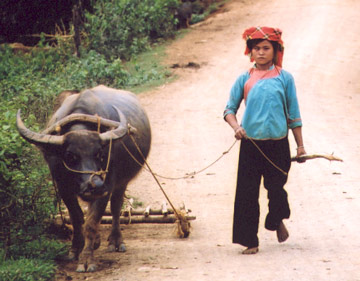
The Giay (pronounced Zay) (above right) are quite widely spread and can be seen not only around Sapa but also in Lai Chau near Tam Duong and in the Dong Van and Yen Minh districts of Ha Giang Province. There are currently 40,000 Giay in Vietnam making them the 25th largest ethic minority grouping. The traditional woman's costume in Lao Cai and Lai Chau Provinces consists of black trousers and a coloured shirt (light or dark pink, light or dark blue, green or white) decorated with a wide band of different coloured material which stretches around the collar and down to a clasp under the right armpit. The ensemble is generally worn with the ubiquitous pattered headscarf seen everywhere. This girl is from a village near Tam Duong.
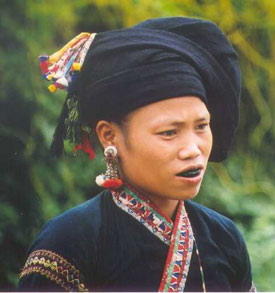
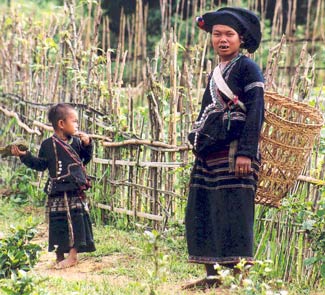
The Lu are a long established ethnicity of the Tay-Thai language group. Their population of just under 4,000 makes them the 40th largest group in Vietnam. Their traditional black and silver coloured clothing is one of the most striking in northern Vietnam, featuring a distinctive black scarf with a silver striped pattern and colourful tassels. The smiling women will also often show you a fine row of blackened teeth. They are now mainly concentrated between Sin Ho and Binh Lu in Lai Chau province. The girl on the left is from the village of Hon, not far from Tam Duong and the lady on the right from near Binh Lu.
 |
 |
 |
|
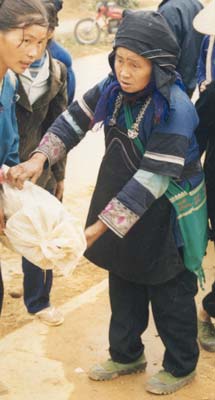
Tu Di are
one of two groups of the Bo Y ethnic minority. The other group - the
Bo Y themselves, are settled in the Quan Ba District of Ha Giang Province.
This lady is a Tu Di of Muong Khuong. With a combined population of
1,500 people the Bo Y - Tu Di are currently ranked 46th of Vietnam's
54 ethnic groups. The Tu Di women of Muong Khuong have adopted a style
of dress similar to their Phi La neighbours and now wear black trousers
and a shirt of black and blue material with a distinctive front panel,
decorated with pieces of coloured material, patches of embroidery
and silver chains: the shirt buttons under the right armpit and has
concentric rings of coloured material around the upper sleeves and
cuffs. The hair is tied in a chignon at the top of the head and covered
by a black turban and embroidery
|
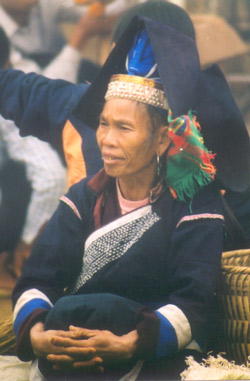
The Pa Di
are a sub-ethnicity of the Tay exclusively settled in the Muong Khuong
District of Lao Cai. Like this lady, they are instantly recognisable
by their distinctive headgear which comprises a studded decorative
headband enclosed in a stiff pyramid shaped black hat. Like their
Thu Lao cousins, the Pa Di women also wear a black skirt, a black
shirt which buttons under the right armpit and a black apron, but
the shirt has a blue border and the shirt features blue and white
rings at the lower sleeves and studded decorative patterns at the
collar.
|
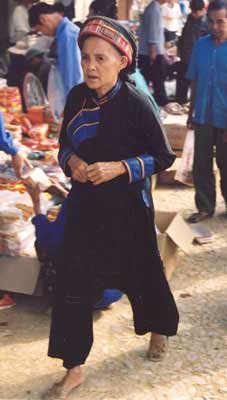
The Tay are the largest
single ethnic minority in Vietnam numbering well over 1,200,000. However
they are often difficult to spot because they dress very similarly
to modern Viet Kinh. However a number wear costumes similar to the
lady above with the black trousers and shirt but with the shirt buttoned
under the right armpit with rings of distinctive blue material here
and at the lower sleeves.
|