Ahmedabad
INDIA 26: GUJARAT. Stage 1
Like last year my preferred way of travel was via Germany with Lufthansa, so a mere 19 hours from Porto, I was in downtown Ahmedabad at the Hotel Good Night.


And the first thing I did was make a little video:
As it was my first day I thought I’d take it easy and just have a stroll around the old town which is entered through the arches of the Teen Darwaza

I wandered down to Rani Sipri’s mosque It was commissioned by Queen Sipri the wife of Sultan Mahmud Begada in 1514. It was a Friday, so there was a sermon but it was fairly quiet.


Then on the way back to the hotel I happened to pass the fish market. As it was the early afternoon it was all closed up but still quite a smell and also nearby was a very unpleasant meat market both of which proved irresistible to a huge number of rather large and threatening red kites.
Then onto the fish market:

I had already decided to go veggie on this trip and this episode underscored my decision. In actual fact Gujaratis are mainly veggie anyway so it wasn’t a problem. My first meal of many would be a veggie thali from the excellent Nishat Restaurant

That evening I went out for another stretch of the legs and came across an intriguing little courtyard. Later I found out it was the Rani no Hajiro, the tomb of Ahmed Shah’s (the founder of Ahmedabad) Queens, built in 1450 and now completely surrounded by newer buildings.
For the following day I had booked a place on the Ahmedabad Heritage walk.
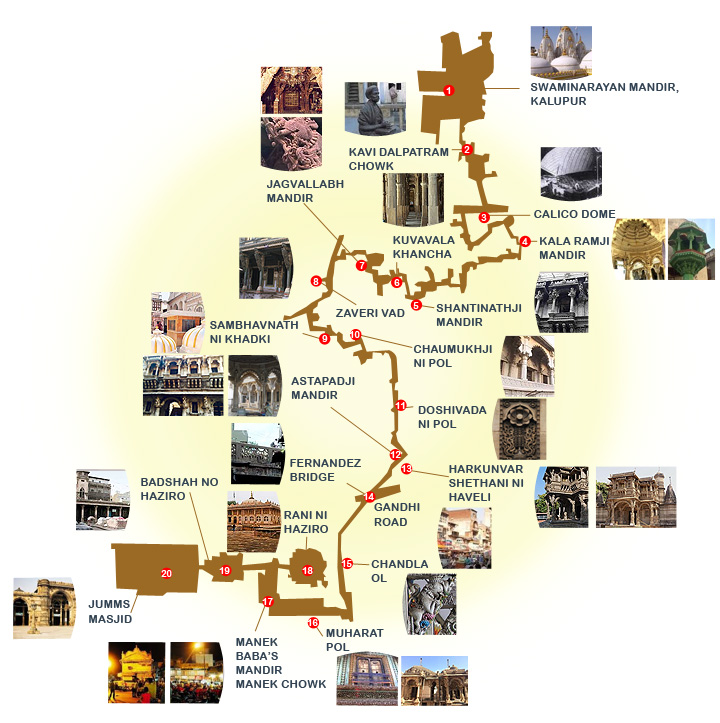
As I was walking I made a wikiloc walk
The walk was really interesting. A bit of a shame they were doing lots of construction around the interesting old properties but I guess they have got a job keeping them up, especially in view of the devastating earthquake from 2001. Also it was difficult to understand the guide.
It starts at the Swaminarayan mandir

and then meanders through the back streets of the old town.

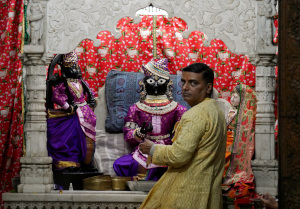
Interestingly at this temple which is also a family home I have seen photos of the black idol (Rama) dressed in a variety of clothes.


The walk ends at the great Mosque


Of course after the walk I went in search of lunch and found it at the Chandravilas Restaurant, although I have to admit the mix of dishes was a bit rich for my taste.

After lunch I took an auto the 10kms to Sarkhej which used to be a small village but has now been swallowed up by the rapidly growing city and so accessed by a rather large and busy road.
Like many Indian Sultans, Mahmud Begada wanted to be buried near to his spiritual guide which was Shaikh Ahmed Khattu and he has the largest mausoleum in this compound which is still an important pilgrimage site. It overlooks a rather pretty small lake and sees few tourists so provides a peaceful respite from what I believe to be one of the noisiest cities in India. Quite some feat.

The Sultan’s tomb, dating from just after he died in 1511, also contains the graves of two of his successors:


After Sarkhej I got a three wheeler back to the hotel to avoid the heat of the day but I was out again in the early evening wandering around the market area of the old town.
8th Feb
The following morning I had pre arranged a visit to the Calico Museum. As the tour didn’t start until 10am, I decided to fit in a visit to the nearby Dada Hari stepwell beforehand. Foolishly I had assumed it would be open. I should have consulted Google maps which this time correctly pointed out it only opens at 10am. Fortunately there was another fairly close by, the Matar Bhavani Vav. Not nearly so well known and now a temple. Built in the 11th century it was an interesting diversion.
Mata Bhavani’s stepwell was built in the 11th century during Chaulukya dynasty rule in Gujarat. It is one of the earliest existing examples of stepwells in India. A long flight of steps leads to the water below a sequence of multi-story open pavilions positioned along the east–west axis. The elaborate ornamentation of the columns, brackets and beams are a prime example of how stepwells were used as a form of art. A much later constructed small shrine of Hindu Goddess Bhavani is located in the lower gallery from which the stepwell derived its name. It was built before the establishment of the modern city of Ahmedabad and is now hemmed in on all sides by more modern buildings.
From here it was a 30min walk to the Calico museum. Although free, it is just as well I had reserved a place as there were a couple of tourists outside when I got there who had been turned away as they didn’t have reservations. They were quite strict as all bags and mobiles had to be left at the gate, hence no photos but it was an interesting tour. There were about 16 others on the tour, one Indian couple, a small party of Thai ladies and another party of English ladies on a guided tour of Gujarat.
The guide was a rather eccentric old lady who had a very theatrical manner. It was a shame that I could understand less than half of what she said. In fact in Gujarat as a whole I was a bit surprised that a lot of people were fluent in English but I still couldn’t understand them! At the end of the tour they gave us a cup of tea and some peanuts as we sat in the attractive garden which was a nice touch.
From here I retraced my steps and did visit the Dada Hari stepwell which was now open. Built in 1499, It is on 6 levels. Like the others there are columned chambers at each level and then at the end an octagonal well just going up. This meant you could either lower your bucket at the traditional well or walk down through the levels.


Behind the stepwell there is an impressive mosque, and tomb of Dada Hari built in the distinctive Gujarati style which is a mix of finely carved Hindu-style post and beams and Muslim-style arched doorways. Dada Hari herself was the superintendent of the royal harem.


From here I got a three wheeler to the Delhi Gate…

..and quickly found the nearby restaurant, Rajwadi Chulha. I’m not sure why I went there because at first glance all they sold were dosas, even pizza or ice cream dosas! However, I spotted the only other patron, who turned out to be the owners daughter and I said I’ll have what she’s having and it turned out to be a very tasty thali!


I carried on walking down the Mirzapur road which turned out to have some very interesting architecture.

…until I got to Rani Rupamati’s mosque, yet another mosque dedicated to a woman, Mahmud Begada’s second wife. It also has her tomb in the complex. The entrance is flanked by two richly carved minarets and in common with many of the local mosques, only the bases are left having fallen during one of the earthquakes, common in the area.


More photos of my exploits in Ahmedabad and HERE
The following day, I was off to Champaner and beyond.