Junagadh
INDIA 26: Gujarat. Stage 5.
Another bus trip. This time more traditional in that we went down old, secondary, tree lined roads with crop fields on either side. An added bonus was that I sat up front with the driver (who was a surprisingly careful pilot) and he dropped me off right in front of my hotel.

The Click Hotel (3700Rs/£30 per night) Strange name but I believe part of a chain. Either way it was very comfortable and highly recommended. Not least because my room had a great view of Mount Girnar, which I was to climb in a few days.

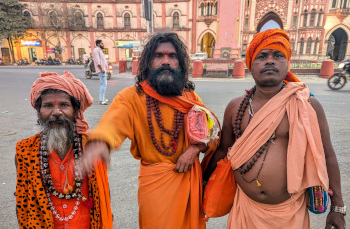
The hotel is next door to the railway station which was actually quite busy as recently they had been celebrating a very important Shiva festival known as the Maha Shivaratri and one of the biggest of these in India is the Bhavnath fair in Junagadh. Apparently thousands of sadhus descend on the town, some naked, to perform various rituals. The sadhus I saw were thankfully clothed and quite happy to chat, despite their serious appearance. I’ve met quite a few on my travels. They are basically wandering holy men who have renounced worldly possessions. Some are friendlier and saner than others.

Like Jamnagar, Junagadh was a princely state in the time of the British and before partition, the rulers were given the decision whether to cede to India or Pakistan. The ruler of Junagadh, the Nawab, was a Muslim and he decided to go with Pakistan. This didn’t go down well with 80% of the population who were Hindus. Suffice it to say the Nawab ended up fleeing to Pakistan and Junagadh became part of India.
The nawab was the last in line of the Babi dynasty which had ruled Junagadh since the 18th century. One of his forbears had built an extravagant mausoleum not far from the hotel so that is where I headed first. The Mahabat Maqbara was built in 1892 and is quite impressive if rather kitch. Here’s a video of the hotel room and then on to the mausoleum.

As I had arrived in Junagadh around lunchtime, I dropped off my gear and headed out. After the Mahabat Maqbara I headed towards the old town in search of lunch. Like Jamnagar a lot of the buildings hark back to Victorian times.

Also like Jamnagar a lot of the restaurants seemed closed but I did find one specialising in Bangladeshi food, The aptly named Restaurant Bangali. It was a muslim restaurant and didn’t look the cleanest I must say, but it was quite popular and I kept to my sort of veggie diet by opting for a fish curry. Very nice it was too.

Suitably refreshed I continued my explorations. Heritage walks seem to be a new thing in India. I went on a guided one in Ahmedabad and while researching the trip I found another for Junagadh. Self guided, but it took me round most of the interesting buildings.


I found this interesting little shop selling spices and also stones. Yes, you are supposed to eat them and they are good for digestion!

On my trip to Junagadh in 1994 I had seen quite a few people in traditional tribal clothing. But not this time apart from these ladies even though the material seems quite modern and doesn’t have the small mirrors or conch shells attached as before.

So that was my first day in Junagadh. I was quite pleased I had booked three nights here as I could see there was plenty more to discover. there are more photos of Junagadh here
18th Feb.
Having that fish curry might not have been the best idea. My stomach was like a clenched fist but I managed a bowl of cornflakes for breakfast. (Fortunately there were no repercussions and I was fine by lunchtime!). As usual I was up early and got to Uparkot fort 10 minutes before opening time. They were a bit of an officious bunch at the gate only opening a bit after 8 and then searching my bag before taking 500Rs entrance fee and an extra 100Rs refundable deposit on a blue rubber bracelet. I had no idea what that was for. Maybe proof of entry?
This ancient fort is believed to have been built in 319 BC by the Mauryan emperor Chandragupta, though it has been extended many times. In places the ramparts reach 20m high. It’s been besieged 16 times, and legend has it that it once withstood a 12-year onslaught. The views over the city and east to Girnar Hill are superb, and within the fort’s walls are a magnificent former mosque, a set of millennia-old Buddhist caves and two fine step-wells. It’s been renovated fairly recently and this site is great for before and after views. When I visited in 1994 I’m sure it was before the renovation but unfortunately I have no photos.
The entrance was certainly very impressive.

The fort is actually famous becasue of its stepwells. One near the entrance is called Lashkari Vav and was though to have been built 2000 years ago, carved out of solid rock.

I then headed up to the battlements with great views over the entrance and the town:


I then headed to the far side of the fort where there was another stepwell, Adi Kadi Vav, again thought to be over 2000 years old but no one is sure.
Inside the fort there is only one main building left. The Ranikdevi Mahal. It was thought to be the palace of a Hindu ruler but then later converted to a mosque. It looks rather boring from the outside after its renovation but is most famous for its 140 pillars.

From here to another stepwell, the Navghan Kuvo. This one has a stairway around the well again carved out of the solid rock and not for the fainthearted.

After a good couple of hours exploring the fort I returned to the entrance. By now all the Indian tourists were arriving and of course, the famous film star that I am, I had to pose for more photos and take a few myself.

On the way back to the hotel, I needed a fizzy drink. I don’t usually drink them except on my India trips where they seem to help me deal with the heat. I never go for a coke or similar but try something local. This time it was cumin flavoured. A bit odd but refreshing nevertheless. I also bought some cake and fruit.
That evening I decided to eat at the hotel restaurant. Obviously I love India having been here numerous times but I have to admit I’m not overly keen on Indian food. i.e. endless curries. Gujarat wasn’t too bad as I ate almost exclusively thalis which are pretty good. Yes they are curries but a variety of small portions. I also usually avoid “foreign” food as the Indian versions are invariably awful. Tonight I decided to take a chance and go off-piste. I decided to go for the only “western” thing on the menu: Mexican pizza! I’m not sure what bit was Mexican but it was quite tasty and vegetarian.

19th Feb. The Mount Girnar adventure!
All quiet in town at 8am when I got an auto to the Mount Girnar Ropeway station. I wasn’t sure what to expect but there wasn’t much of a queue at the ticket office so that was good. The lady asked my name. I said Richard. On receiving my ticket (700Rs) it had my name: Vicjten! and also the booked time 9-10 am (it was 8.10 so I guess I had a bit of a wait). I was then ushered into a huge hall packed with people where I took a seat. It seemed to be organised chaos. Every now and then a row of people were ushered through another door and soon enough it was our turn although I seemed to be with an entirely different group of people. Here was a new queue and then I was with a group of Italians and we got into a gondola. Organised rather like a ski station. I guess that’s what it was.


Obviously great views on the way up but I did feel a little uneasy when we stopped three quarters of the way up and the gondola started swinging in the wind! Once at the top even better views. Here it was apparent that we were on one of a number of peaks inside an enormous volcanic crater created thousands of years ago.

From the ropeway station I followed the path up to a temple on one of the peaks. Great views but so windy!

Looking down at the biggest Jain temple on the mountain and beyond that the village at the base of the mountain, where the ropeway starts and beyond that the city of Junagadh in the distance. Rather than get the ropeway back down I decided to walk the 6000 steps. It didn’t feel too bad at the time but the following day my calves had completely seized up! The Jain temple just visible in the photo below is very famous and contains the black Nimanth. An idol made of black granite with crystal eyes. I had to leave all my belongings at the door so no photos obviously but it was amazing to see inside. There were groups of monks and pilgrims, many chanting and it was very dark and atmospheric inside this 800 year old building.


Back at the foot of the mountain time for lunch, yes another thali.

Not so photogenic but a personal highlight of the whole trip was to visit the Ashoka edict. Mount Girnar has been famous for centuries and in 300BC Ashoka ordered for one of his edicts to be inscribed in a boulder here. The Edicts of Ashoka are a collection of more than thirty inscriptions attributed to Emperor Ashoka of the Mauryan Empire who ruled most of the Indian subcontinent from 268 BCE to 232 BCE.
These inscriptions were dispersed throughout the areas of modern-day India, Bangladesh, Nepal, Afghanistan and Pakistan, and provide the first tangible evidence of Buddhism. The Edicts are the earliest written and datable texts from India, and, since they were inscribed on stone, we have the added benefit of having them exactly as they were originally inscribed. A personal highlight to see them as I had recently read Ashoka by Charles Allen, describing the greatest Emperor of ancient times and someone surprisingly little known in the west.


I found an interesting blog post which some may find interesting. No doubt more interesting than this one! There are more photos of my adventures in Junagadh and Mount Girnar here
So that was Junagadh. Next stop the lions of Gir forest!